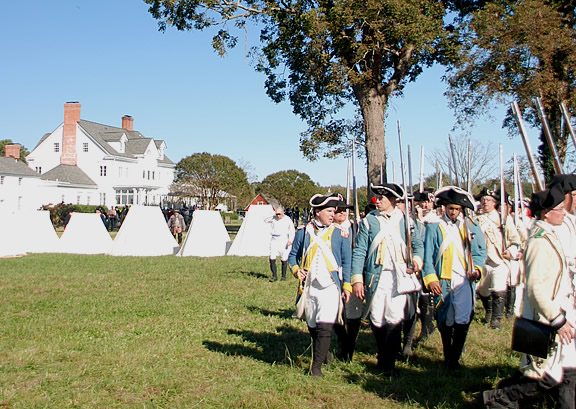
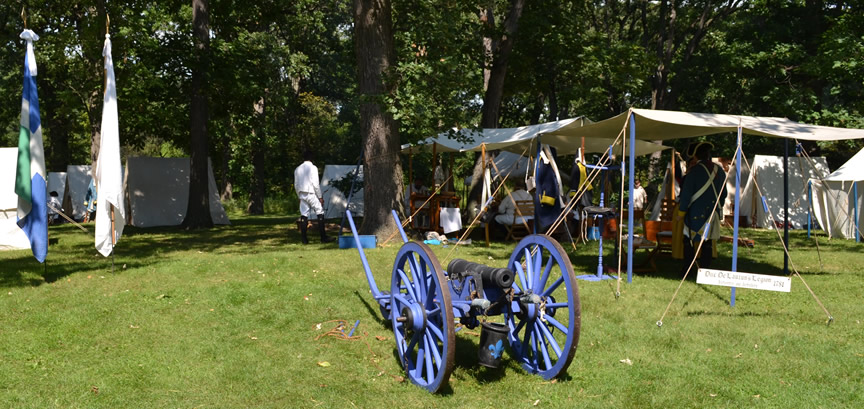
also known as Lauzun’s Legion.
It was commanded by Armand Louis de Gontaut, the Duc de
Lauzun.
The legion first formed as the Volontaires Étrangers
de la Marine
(Foreign Volunteers of the Navy) in
1778. This new corps was
formed for colonial service and the
Marine was responsible for colonial operations.
By October 28th, 1778 part of this new Legion, commanded
by Lauzun, was on it's way to
Senegal in Northwest Africa to recapture
France's slaving stations from
the British. By January 30,
1779 they reached
Fort St. Louis and after a brief operation
the British surrendered.
Documents show that part of the Volontaires
Étrangers de la Marine were
with d'Estaing at Savannah, Georgia in September 1779.
A 1779 edict amalgamated Lauzun's
corps with that of the Volontaires
Étrangers de Nassau and late in 1780
the Legion was renamed Volontaires Étrangers de
Lauzun
(the Foreign Volunteers of Lauzun). This new Legion
was
composed of 5 companies of infantry
consisting of 2 companies of Fusiliers, one
Grenadier, one Artillery and one Chasseur
company; and two troops of hussars (cavalry), each
composed of one company of French
hussars and one of Polish lancers.
The decision to send troops to America (Expedition Particuliere)
under the command of the Comte
de Rochambeau was made late 1779.
Lauzun asked that he and his Legion
be part of this army which was agreed to by Rochambeau
and on April 12, 1780 the troops
embarked at Brest but, as a result of bad weather, the
convoy did not sail until May 2.
The fleet arrived on July 11th off the coast of Newport,
RI and, upon arrival, had to
purchase horses for the hussars and
officers. During the remainder of
1780 and into 1781 the Legion was
used as guards for protecting the wagons coming from
various ports bringing supplies and
money to Rochambeau.
Later in July, Lauzun and his Legion were ordered
to reconnoiter the outlying areas of
New York and on July 21, accompanied
by Americans under the command of General Lincoln,
were ordered to take Fort Knyphausen, near Morrisiana-Kingsbridge
(now the Bronx).
The operation was unsuccessful, but the Legion distinguished
itself providing rear-guard protection
for the retreating American troops.
The French army, shortly thereafter, began the long march
towards Yorktown, Virginia.
After a 400 mile march the Legion was ordered to Gloucester
to prevent Cornwallis from using it
as a possible escape route and was
augmented by the addition of sailors
and soldiers off the French ships blockading of the bay.
October 4th, a confrontation between Lauzun's Legion and
Tarleton's British Legion took place
with the Legion the winner. Yorktown surrended
October 19, 1781 and Gloucester Point a few hours later.
The Legion remainded in American for two more years representing
France's interests
until the Treaty of Paris was signed and American Independence
assured.